Gamification of Learning: Making Education Fun Through Play
Learning something new can feel like climbing a mountain - challenging, sometimes frustrating, and requiring persistent effort. But what if that mountain climb came with power-ups, achievement badges, and friendly competition? That's the magic of gamification, a powerful approach transforming how we acquire knowledge and build skills.
What is Gamification?
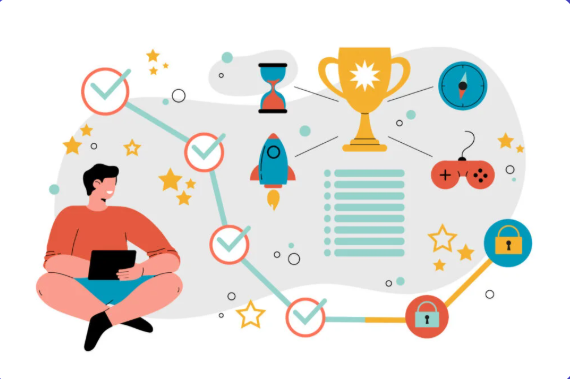
Gamification applies game design elements and principles to non-game contexts—like education—to enhance engagement and motivation. It's not about turning everything into a full-blown video game, but rather incorporating game mechanics into learning processes to make them more enjoyable and effective.
These game elements might include:
- Points and score systems
- Achievement badges and rewards
- Progress bars and levels
- Leaderboards and social competition
- Narratives and characters
- Immediate feedback loops
At its core, gamification taps into our natural desires for mastery, autonomy, social connection, and, most importantly, fun. Research shows that gamification in education can significantly boost student engagement and learning outcomes when properly implemented. One study found that challenge-based gamified learning improved student performance by nearly 90% compared to traditional lecture-based education.
Why is Learning So Hard?
Before diving deeper into gamification, let's understand why learning can be challenging:
1. The Attention Problem
In our distraction-filled world, focusing on learning materials for extended periods has become increasingly difficult. Our brains naturally seek novelty and immediate rewards—something traditional education often fails to provide.
2. The Motivation Gap
Learning frequently requires delayed gratification. You might study for weeks before seeing tangible results, which conflicts with our brain's preference for immediate rewards. As psychologist Wendy Wood notes, "The rewards for habit formation need to be immediate," because dopamine, a key neurotransmitter in reinforcing behaviors, operates on a timescale of seconds.
3. The Forgetting Curve
Our brains are designed to be efficient, which means they prioritize remembering information deemed important and frequently used. Without regular review, we quickly forget what we've learned—a phenomenon psychologists call the "forgetting curve."
4. The Tedium Factor
Traditional learning methods can feel monotonous. Reading textbooks, watching lectures, and taking notes without variation taxes our mental resources and diminishes our enthusiasm over time.
How Gamification Makes Learning Fun and Builds Habits
Gamification directly addresses these challenges through several key mechanisms:
Instant Gratification
Unlike traditional learning where feedback might come days or weeks later, gamified platforms provide immediate rewards—points, badges, level-ups—that satisfy our brain's craving for quick wins.
Progress Visualization
Seeing your progress through visual representations like filling bars, collecting achievements, or advancing through levels creates a sense of accomplishment. This visualization makes abstract learning concrete and satisfying.
Social Dynamics
Humans are inherently social creatures. Gamification leverages this by incorporating elements like leaderboards, team challenges, and social sharing. These features tap into our natural desire for connection and healthy competition.
Narrative and Context
Learning facts in isolation is difficult. Gamification often weaves learning objectives into compelling narratives that provide context and meaning. This storytelling aspect helps information stick by connecting it to emotions and experiences.
Lowered Stakes for Failure
In games, failure is expected and often entertaining. This mindset shift reduces anxiety around making mistakes, encouraging experimentation and risk-taking—essential components of effective learning.
The Compound Effect: How Gamified Learning Habits Lead to Mastery
When learning becomes enjoyable through gamification, something remarkable happens: we develop habits that compound over time.
Research in habit psychology has shown that approximately 43% of our daily actions are habitual—things we do automatically while thinking about something else. These habits free up mental resources for more complex tasks.
The science of habit formation reveals that repeatedly performing an action in a consistent context leads to automaticity through associative learning. Once these learning habits are established, they persist even after motivation wanes because they're triggered by environmental cues rather than conscious decision-making.
For instance, a student who associates checking a language learning app with their morning coffee ritual eventually performs this action automatically. This automation is critical because:
-
It bypasses willpower limitations. Willpower is a finite resource, but habits operate with minimal conscious effort.
-
It creates consistency. Learning consistently, even in small doses, dramatically outperforms occasional intensive study sessions.
-
It enables compound growth. Small daily improvements lead to remarkable long-term progress through compounding effects.
As these gamified learning habits become ingrained, users experience the "virtuous cycle" of learning: progress generates satisfaction, which increases motivation, which drives more progress, creating sustained engagement over time.
Ankiverse: Gamification Meets Spaced Repetition for Language Learning
A prime example of effective gamification in learning is Ankiverse, an innovative platform that combines proven spaced repetition techniques with engaging game elements to accelerate language acquisition.
The Power of Spaced Repetition
Spaced repetition is a learning technique where information is reviewed at increasingly longer intervals, precisely timed to occur just as you're about to forget it. This approach aligns perfectly with how our memory works, making it incredibly efficient for long-term retention.
Traditional spaced repetition software like Anki has been used by language learners, medical students, and knowledge workers for years. However, while effective, these tools often lack the engagement elements that keep users coming back day after day.
How Ankiverse Transforms Language Learning
Ankiverse takes spaced repetition to the next level by wrapping it in a carefully designed gamified experience that makes language learning both effective and enjoyable:
Immersive Learning Environment
Instead of simple flashcards, Ankiverse creates contextualized learning scenarios that simulate real-world language use. Learners progress through an evolving narrative that keeps them invested in the learning journey.
Adaptive Challenge Levels
The platform intelligently adjusts difficulty based on user performance, keeping learners in the "flow zone"—where challenges are neither too easy (boring) nor too difficult (frustrating), but optimally engaging.
Social Learning Communities
Language learning thrives in community. Ankiverse facilitates connections between learners, creating accountability partners and friendly competition that drives consistent practice.
Reward Systems That Matter
Beyond superficial points, Ankiverse's rewards are tied to meaningful progress markers. Achievements celebrate real milestones in language proficiency, providing authentic satisfaction.
Habit-Building Design
The platform incorporates proven habit-formation techniques, from customizable notifications to streak systems that encourage daily engagement until learning becomes automatic.
For instance, users might advance through a virtual world where they unlock new areas by mastering vocabulary sets, compete with friends in weekly challenges, and earn rewards for maintaining consistent practice streaks.
Why This Approach Works: The Science Behind Success
The combination of gamification and spaced repetition in platforms like Ankiverse isn't just intuitively appealing—it's backed by cognitive science.
Studies show that students in gamified courses can outperform their traditionally-taught counterparts by as much as 40%. The engagement provided by gamification helps learners concentrate better on their studies, while the spaced repetition algorithm ensures information moves efficiently from short-term to long-term memory.
Neuroscience research explains why this works: as we practice retrieving information at spaced intervals in an engaging context, we strengthen neural pathways, making recall easier and more automatic. Meanwhile, the gamified elements trigger dopamine releases that reinforce these learning behaviors at a neurochemical level.
Building Your Gamified Learning Practice
Whether you're using Ankiverse or another gamified learning platform, here are strategies to maximize your results:
-
Start small: Begin with 5-10 minutes daily rather than ambitious multi-hour sessions.
-
Link learning to existing habits: Attach your learning practice to something you already do daily, like drinking morning coffee.
-
Create environmental triggers: Keep visual reminders or set up your environment to prompt learning activities.
-
Celebrate milestones: Acknowledge your progress in meaningful ways to reinforce the behavior.
-
Find learning partners: Connect with others pursuing similar goals for accountability and motivation.
-
Be patient: Remember that habit formation takes time—research suggests around 66 days on average for a behavior to become automatic.
The Future of Learning is Playful
As we look ahead, gamification in education will only become more sophisticated, personalized, and effective. With advances in artificial intelligence, learning platforms will better adapt to individual learning styles, preferences, and goals.
The most exciting development, however, might be the cultural shift toward viewing learning not as a chore but as an enjoyable, lifelong pursuit. By transforming learning into play, gamification doesn't just make education more effective—it makes it more human.
So whether you're learning a language, developing professional skills, or pursuing knowledge for its own sake, consider how gamification might transform your educational experience. The journey to mastery doesn't have to be grueling—it can be fun, engaging, and built on small, consistent habits that compound over time.
After all, perhaps the most powerful lesson from gamification is that learning, at its best, is a form of play. And play has always been humanity's most natural way of growing, connecting, and discovering the world around us.
Discussion
Have thoughts, questions, or insights? Join the conversation!